The Importance of Art Education: Nurturing Creativity for life

The Importance of Art Education: Nurturing Creativity for life

“The benefits of the visual arts are lifelong. Visual art does not have boundaries. It enables people to play with materials, to express their thinking, to problem solve and make sense of emotions,” says Dr Lindsay, Lecturer in Early Childhood Education at the University of Wollongong’s School of Education, “Art makes us resilient, it is great for problem solving and understanding the world. It helps us develop our creativity across every aspect of our lives.”

Innovative thinking

As we head into a new era of technological development, with advances in Artificial Inteligence, robotics and other various science-based wonders, it would be a mistake to dismiss the human element in education. Arts education – across all creative fields – visual arts, performing arts and music – all contribute to the development of innovative thinking.

We are at a precipice. At the moment AI is functioning on what we have and can input into a dataset. It is not functionally sentient. It is interpreting human content, rearranging, and presenting it back to us. It is not creating something completely new and unique. It is an amalgam of human achievement. Once AI and quantum computing become both prevalent and stable, these systems will be self-sustaining, and the space left for humans will be in creative innovation.

The creative element of new endeavor remains the domain of people. Skills for the future of humanity, and future economic participation are deeply rooted in arts education.

NAAE (National Advocates for Arts Education) advocates for the inclusion of Arts in STEM (Science, Technology, Engineering and Mathematics) to create STEAM (Science, Technology, Engineering, Arts and Mathematics) in order to better prepare students for the future. We don’t know what the jobs of the future will look like. Many jobs that exist today were unheard of 40 years ago. A diverse and thorough education gives our children the best possible foundation for the future. While specialization is important, a strong foundation provided necessary skills for future learning.

Transdisciplinary engagement

Skills from Arts education, and their outcomes are important for transdisciplinary engagement – from critical and creative thinking to communication with collaboration and teamwork. One example of this is science communicators. Interfacing between science, media and the community requires a skillset that is not found solely in STEM education. Communication and teamwork skills are intrinsic to a school drama class. Should a student be exposed to both STEM and Arts learning, there is the opportunity to engage and understand interpersonal creative learning.

We also should not think that creativity is limited to the arts. An engineer without creativity is unable to ideate to develop, design and build a bridge. We should not underestimate the amount of creativity across all STEM disciplines. By also being exposed to Arts education, we encourage people to experiment and grow, skills which can then be applied to all aspects of life and learning.

Enriching lives

Aside from flexible career skills, arts education also benefits people in everyday life. A willingness to experiment and problem solve is vital to many aspects of life, from organizing your household, cooking delicious food, communicating with friends and family or even developing fulfilling hobbies.

As mental health is becoming better understood, the balance arts provide for some is invaluable. The arts cultivate empathy, cultural understanding, and creative thinking, fostering well-being, empowerment, and a deeper appreciation of the human experience.

Benefits of arts exposure is not limited to individuals, as engagement with public arts projects creates a sense of belonging and community. Art nurtures and enhances problem-solving skills, and encourages innovation. Perhaps bringing people together to spark new business or social enterprise.

A more colourful, creative life experience

Irrespective of whether a student goes on to practice art as an element of their career, learning the fundamental skills associated with the arts is beneficial in all aspects of life, both working and personal. Lifelong learning of any kind enriches and enhances experiences not only in the direct area of study, but across all aspects of human experience.

Cover image by Alexander Ant / Unsplash

Behind the scenes on a very beachy Christmas

Behind the scenes on a very beachy Christmas

Christmas gives us an opportunity to create something unique – something to celebrate the season and the year that has been, and the year to come. Each year we try to create something engaging, fun and different.

Some years these ideas flow easily, others take a little more time. The KRD Christmas project is put on the WIP list on 1 July, and we keep a file of ideas. These then tend to be formed into a single direction later in the year.

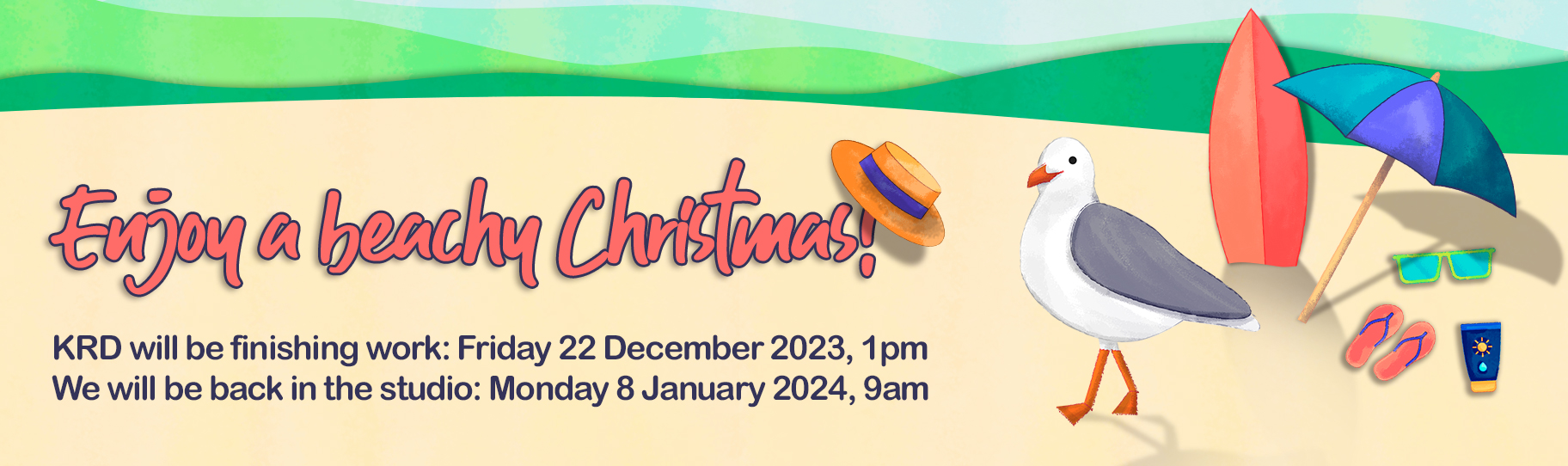
This year’s theme ‘a very beachy Christmas’ developed to combine the shared European (winter) history of Christmas with the Australian experience of a summertime celebration.

Starting point is the end format

Our starting point is knowing the formats we want to produce. In years past, this was mostly printed with a simple digital accompaniment. This year we started with the knowledge we wanted to create an animation as the primary piece. We also need a suite of material for social media, emails and our website. In the studio it gets a job number and treated like a client project, and is worked on incrementally as workflow allows.

Our starting point for this years animation sequence was Australian flora and beach landscape imagery. This becomes the overarching theme and narrative.

This is the point where we create (now digital) mood boards to capture the type of imagery, colour, vibe and aesthetic for the project. Initially we work on simple sketches to communicate ideas within the team.


Inspiration

When deciding the graphic style of the pieces we find a lot of varied inspirational images for both techniques and styles. The beach theme brought the broad brush stroke textures to our rendering, reminiscent of sand. The illustration components are simple shapes that get their personality from the colour and textures used.

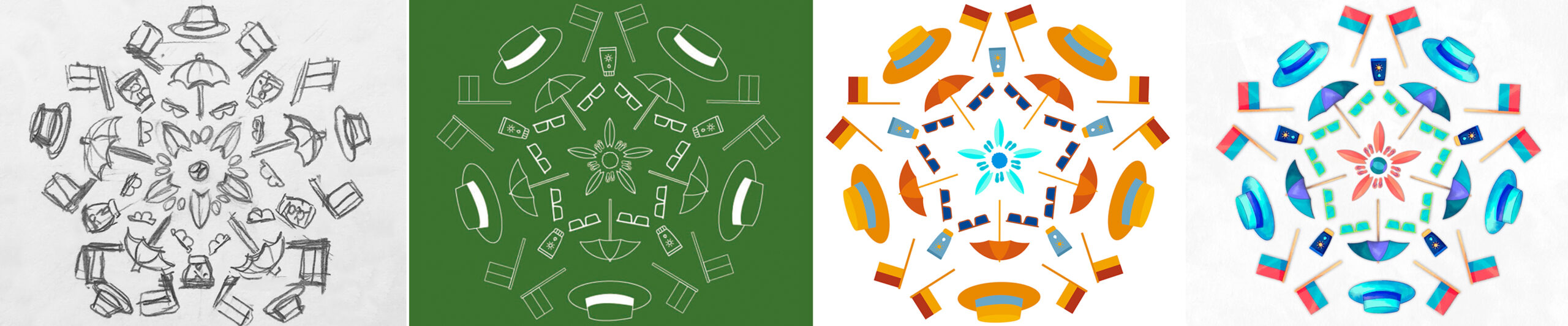
Sometimes along the way, there are happy accidents. In this case, when storyboarding an animation of a flower made from beach themed icons, it was noted that the final frame looked a lot like a snowflake. And so, the idea of a summer snowflake began.

The idea that a traditional motif from a European Christmas could be flipped to an Australian summer theme was the hook needed to bring the project to conclusion. Taking the motif of the snowflake, we altered this to apply to summertime.

Thematic colour choices

Initially we were working with the traditional Christmas colours, but this was not creating the look we were after. Changing the colours of a piece can do so much to change the feel and the messaging.

To really push this to an Australian theme, we needed to find a colour pallet that communicates ‘Australian’ and ‘summer’ that was also beautiful and sophisticated. We drew inspiration for our colour pallet from Bluey, which so wonderfully illustrates the Australian landscape using tertiary colours for nuance and feeling.

Final storyboarding and test animation

The next storyboard was made to show how we could bridge the two vastly different Christmas environments together. This included how the scenes would transition, how the individual elements would move and the timing. Also, how this would incorporate our Christmas messaging. An idea of a scene was developed for the summer snowflake to morph into, including an iconic seagull who would become the star of the production.

All elements were then built and illustrated as separate components to be synchronised within the animation, with final testing focusing on the speed of transitions and incorporation of sound effects and music to complete the scene.

Reaching our audience

To serve a business purpose, the animation must also incorporate important dates and information. The end credits are a signoff to the animation, but are also covered elsewhere to ensure consistent messaging. From a business perspective, it would be nice to think everyone in our audience will watch all of our video. We know however, that audiences are fragmented, and consume media and information from varied sources. As such, it’s important that vital messaging is repeated in different formats and locations.

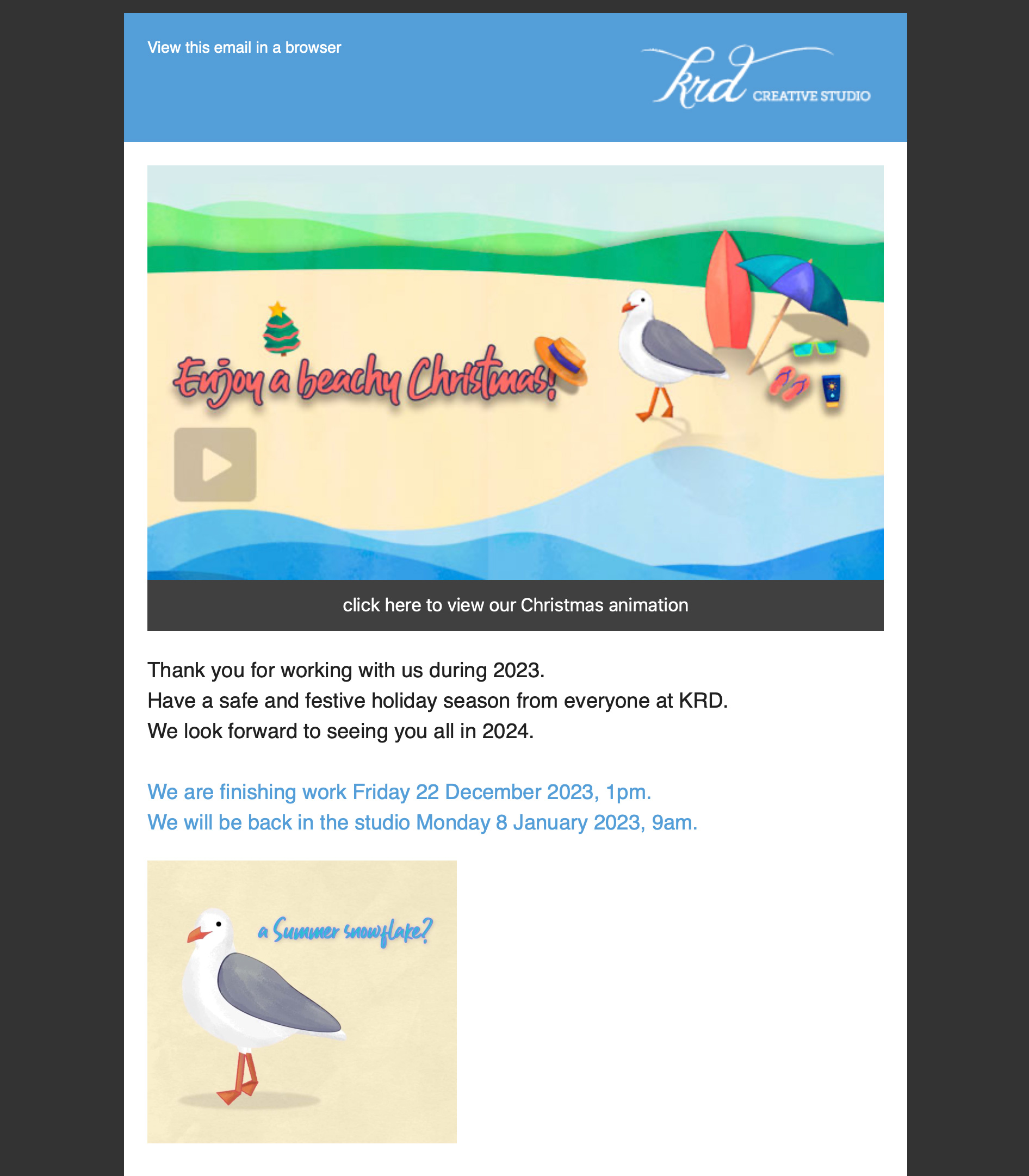
The final step in what becomes our ‘Christmas Campaign’ is to ensure that our messaging is distributed effectively. That means sending the video as part of an eDM, incorporating matching messaging in our email signatures, posting to socials, and even putting this article up on our recourses page. Ensuring that messaging is across as many touch points as possible to reach our audience how they like to consume information.

Why precise measurements are critical for graphic designers

Why precise measurements are critical for graphic designers

Let’s talk about measurements. In engineering, manufacturing and scientific applications, measurements deal in thousandths of a millimetre, or smaller. Mechanical engineers use digital Vernier calipers, outside micrometers, pitch gauges and feeler gauges for precise measurements. These can measure up to 1/1000 of a millimetre.

For graphic design that will be printed, we deal in millimetres. For design with a digital outcome, the units are pixels. Printers use outside micrometers to assess the thickness of paper. At the intersection of graphic and product design, microns come into play. The need for precision in our industry is pivotal in ensuring the accuracy and professionalism of our work.

In graphic design, even the slightest deviation from the intended measurements can result in errors in printing and binding, or significant visual discrepancy in online applications. Whether it’s creating a print design, a web layout, or a logo, precision ensures that the final product aligns perfectly with the designer’s vision and adheres to the client’s requirements. Accurate measurements also contribute to the overall consistency and coherence of a design, which are crucial factors in maintaining a strong brand identity.

When briefing projects, clients should provide clear instructions. This may require supplying a specification sheet for both web and print advertising, pop-up banners or promotional items. It may mean delivering a sample of items to the designer or printer to be measured for packaging and point-of-sale. This is then used in the creation of a dieline either by a printing company using a CAD system, or by the designers for simpler projects. The client may be working with architects, engineers, or a signage company. They will have CAD drawings, and these should be supplied to the designers. Consultation is key in all instances.

Occasionally for practical reasons, the client may need to measure a product or point-of-sale display. Our suggestion is this is usually best as a two-person process. Someone should hold the ruler straight against the item and someone else take a photo, clearly showing the edges and where the markings on the ruler line up.

A day in the life of a design studio

A day in the life of a design studio

A design studio is a fast and flexible working environment. Projects vary in size and scope, with often concurrent timelines. The team dynamic is important to keep things running smoothly to ensure we complete projects with upmost quality, on time. As a small studio, KRD team members work on projects both end-to-end as well as shared between us.

Project planning

At the start of the week, we discuss upcoming projects for the week, timelines and delegate tasks. Often projects are continued over from the previous week, and new ones are added in throughout the week.

Projects in the studio are assigned a client unique code, which allows for easy tracking and filing. For our larger clients this is indispensable, as we constantly reference previous jobs for images or text. We store all these codes – along with brief descriptions – in a database hosted on our server. This is accessible and searchable on our network via a browser.

For clients that we prepare work for on an ongoing basis, and we often have larger regular projects that require updating. A lot of imagery is stored on our server for easy access, or we access imagery via the client’s media library, available online.

Project management

Depending on the stage of a project, we may receive feedback or changes via email or phone. Clients may visit the studio to sit with us and work on changes in real time. Post-Covid, we also utilise video calls for briefings and more complex project alterations.

Days often vary with the kinds of projects in the studio; larger data intensive projects such as video editing take hours of time. Smaller tasks like web image creation or retrieval, or small edits to print pieces can be quick, again depending on the project. When one team member has larger projects to work on, we move the smaller tasks around.

For more complex design tasks, like brand development, everyone gets involved. We will work on research and concept sketches, then view them together to discuss direction. Smaller projects can also present interesting design challenges. This is especially true for pieces that need to fit a lot of information in a tiny space. When this happens, we reach out to the team for thoughts – sometimes a solution is easier to find when you’re not in the middle of a project.

Variety of work

The types of projects can range from print through to digital. In the morning we may be working on catalogues, packaging and point-of-sale. The afternoon may bring website updates, social media campaigns and video edits. Interspersed is writing and editing content, project management, print deliveries, and, always managing deadlines with client and suppliers.

Urgent requests

Occasionally there are super urgent requests. These are often to supply print and/or digital advertising when Marketing teams are offered distress rates from magazines. This is known to happen on Friday afternoons and can mean last minute finishing and uploading to meet the print deadline, often with a level of panic involved.

Brand Guidelines

Much of our client work involves careful understanding and following of brand guidelines. We pay careful attention as global brands are constantly refining their corporate identities with new assets or adaptations for evolving technology. This information is shared between the team and discussed regularly.

Larger projects

For larger projects, there may be site visits, eg. Interpretative signage or collaboration and input from suppliers. This may be with a marketing consultant, copywriter, photographer/videographer, printing companies or manufacturers. Suppliers often visit the studio, calling in with samples, deliveries, and answering important production questions. There is constant managing of deliveries of printed materials and following up on delivery receipts.

For point-of-sale projects we often create print tests and take to a local retailer to check instore. This is vital to ensure measurements are correct and materials will work in the situation required. Particularly on complex projects there can be new products/methods/technology and this will require liaison between ourselves and suppliers, including press checks and factory visits during manufacturing.

Pack and despatch

From time-to-time we undertake pack and despatch. This may be intricate mail outs requiring careful attention and specialised gift wrapping. The studio can become a small factory on these days, with a couple of Studio Assistants helping. Larger projects are worked on by mailing / fulfilment houses.

Team interaction

Importantly, a small team needs time to converse each day and keep up to date with relevant local, national, and international events. At various times of the day there will be lively conversations. For example, we discuss podcasts, articles or books we’ve read, TV shows, movies, and all kinds of pop culture. Like most teams, we have numerous ‘in-jokes’. We quote lines from the IT Crowd. We share stories on technology gripes with all major software updates. We discuss our personal projects. Recipes are shared. Traffic and weather anecdotes are on high rotation. As we’ve noted in our article ‘What makes designers tick?’, we believe in life-long learning and constant curiosity of the world around us to enhance our daily design journey.

The Power of Visual Storytelling

The Power of Visual Storytelling

Visual storytelling starts for most people with picture books when they’re children. Images form an integral part of the story message. The images and text combine, creating evocative messaging to resonate both intellectually and emotionally.

Visual storytelling is the essence of graphic design. Graphic designers take information and present it in a way that makes sense, tells a story. In today’s media landscape, visual storytelling is increasingly complex, with various mediums to communicate through. Effective and cohesive visual storytelling must work across print and digital media, including static and video or animation formats.

With a more complex environment, and an increasingly crowded marketplace, it is important for brands to create consistent, engaging and relevant visual material. To be able to cut through the white noise, a brand must stand out with unique, compelling visual stories.

Imagery – especially video – can convey much more in a few seconds then a headline ever could. Video stories are dense communications, while also being simple for a viewer to decode. Consistent branding and brand story allows for a whole ethos to be communicated through a short video, viewed in context. The viewer needs to bring less knowledge to the interaction.

Entertainment value

Successful and engaging visual storytelling leans more heavily towards emotions and entertainment than product information. An example KRD worked on is the #LikeABosch campaign for BSH Home Appliances – where videos created by the Bosch Gobal team combine humor and product interaction to create engaging social media advertising material. The campaign also allowed for still imagery to be taken from the videos to use across various print and outdoor advertising sites for consistent visual storytelling. The #LikeABosch campaign was produced in Germany, and adapted by KRD to local market requirements. Global campaigns for BSH have flexibility for in-country modification.

The #LikeABosch messaging is a parody of “Like a Boss”, which itself is a parody by comedy hip hop troupe The Lonely Island, of a song by hip hop artist Slim Thug. The campaign draws upon the comedy credentials of the parody it is parodying – so has layers of meaning and cultural reference which go a way to explaining the more outlandish ‘stunts’, like the toddler with a bottle throwing it into the dishwasher. If you want to see the original parody, there are clean and explicit versions available on YouTube.

Visual storytelling has the ability to reach multi-lingual audiences, as it is not reliant on words. The #LikeABosch campaign was produced in many languages worldwide which meant that the humor was conveyed as a whole – however there are enough sight-gags to still be entertaining without sound and language.

By using parody, the #LikeABosch campaign was able to capitalize on trending themes, and stand out in a crowded marketplace. At the same time, the humor of the clips stands alone for audiences who are not familiar with the existing parody.

Visual storytelling is at the core of what we do as graphic designers. It is not limited to motion graphics, or story books. Every piece of graphic design work produced is a vehicle for storytelling – communicating a message. Video marketing allows us to add layers to the messaging that may be limited across other mediums. How effectively this message is conveyed is the measure of successful visual storytelling.

Image created with assets from unsplash, ballons by Jean-Philippe Delberghe, landscape by Johanes Plenio

Design museums and galleries – Part 1

Design museums and galleries – Part 1

by Kym Ramadge, June 2023

This is Part One of a subjective list of European museums and galleries I have sought and enjoyed for their art, architecture, curation, interpretative signage and ambience. Some focus on design history, some on the cutting edge. Some combine historical collections in contemporary buildings where the viewer has the best of both worlds. Design is a broad theme and covers, graphic, industrial, photography, textile, applied arts and technology.

As an Australian, the joy I’ve had experiencing European culture first-hand has been both awe-inspiring and humbling. I fully appreciate the opportunities I’ve had and would encourage all design students and graduates to maximise this aspect of travel at their first opportunity. Viewing artwork, objects and all forms of design, in person is unbeatable.

A well-travelled, European client of ours once defined it as this: ‘Australia and New Zealand are unsurpassed for landscapes but if you want to see the finest cities, go to Europe. Each localities have their strengths, and we should embrace the positive of where we currently are.’

Many of these choices to visit were influenced by material studied in the history/theory component of my graphic design degree at the former Phillip Institute of Technology (incorporated into RMIT University, 1992 during our final year).

An over-arching theme is the recognition of the continuity designers are part of. We are formed and guided professionally by previous generations, even if we are not aware of it. The museums and galleries discussed here all curate and display the talents of skilled artists, designers, craftspeople, architects both historical and contemporary.

London, UK

The Type Archive

http://www.typearchive.org/

I was fortunate to meet Susan Shaw and tour The Type Archive in January 2019. The pivotal trove of typographic and print knowledge collected here is difficult to distil into a summary.

From the TA website:

The Type Archive is home to the art of printed words. We hold an amazing collection of letterpress fonts in metal and wood which celebrates the joy of printing: the craft that has served as the fundamental basis of modern civilisation and graphic design. While modern type foundries are entirely digital (Monotype.com) the Type Archive’s collection spans the nearly 600-year period when the foundry cut letters in steel, drove them into brass blanks, and cast lead type from them in molten lead.

Unfortunately, the TA is unable to stay at its present location. According to the website, the collection is to be moved to the SMG site at its National Collections Centre near Swindon.

The SMG plan to conduct oral history interviews to ensure the Monotype skills are recorded for the future. Once this is resolved, I highly recommend a visit. Appreciating the history of typography is imperative for all designers.

Type Archive photographed by KR, January 2019 in Lambeth, including hot metal type and Monotype machinery.

Victoria & Albert Museum

https://www.vam.ac.uk/

The Victoria and Albert Museum is a must see, both for the temporary exhibitions and the permanent collection. One tip for any European museum is to get to the top floor first and work your way back down. This can be a way to skip the overly crowded sections near the front doors.

From the Victoria and Albert Museum website:

Henry Cole, the V&A’s first Director, declared that the museum should be a “schoolroom for everyone”. Its mission was to improve the standards of British industry by educating designers, manufacturers and consumers in art and science. Acquiring and displaying the best examples of art and design contributed to this mission, but the ‘schoolroom’ itself was also intended to demonstrate exemplary design and decoration. The story of the design and construction of the V&A’s buildings, and of the personalities who guided this process, is one of persistent vision and ingenuity, amid the changing artistic, political and economic circumstances of the last 150 years. 

The curation and interpretative design at the Victoria and Albert Museum is inspirational. Everything from the colours chosen on the walls, to the exhibition layout, to the signage, the building, to the objects themselves is compelling. I cannot single out one particular favourite area here.

The main part of the Victoria and Albert Museum is free for all to visit. So, you can visit as many times as you like without museum fatigue. Temporary exhibitions can involve an entrance fee. Check the website for current information.

The V&A building interior is as much a part of the collection as the objects themselves! The far left image ceiling is by William Morris and is a timelessly beautiful pattern.

The Courtauld

https://courtauld.ac.uk/gallery/

Located in Somerset House, the Courtauld is awe-inspiring. The scale is intimate, and the collection of Impressionist, Post-Impressionist and Fauve paintings is one of the world’s greatest. The Courtauld also features temporary exhibitions.

Bookings are required, check the website for current information.

Museum of Brands

https://museumofbrands.com/

Quirky, nostalgic museum located in Notting Hill. Showcasing 150 years of consumer culture. Not all the brands will be familiar to Australians, however, the sheer volume and the division into eras makes this unmissable for designers or pop culture aficionados. The fonts, colours, period styling, printing methods and embellishments, all add up to a 3D design extravaganza.

The museum runs temporary exhibitions as well as archives and other resources for our industry.

From the Museum of Brands website:

More than fifty years ago consumer historian Robert Opie began to unravel the fascinating story of how consumer products and promotion had evolved since Victorian times. By 1975 Robert had enough material to hold his own exhibition, The Pack Age, at the Victoria & Albert Museum. In 1984 he opened the first museum devoted to the history of packaging and advertising in Gloucester.

In the early 2000s, the collection needed a new home. With the help of global brand agency pi Global and founding sponsors Cadbury, Twinings, Vodafone, Diageo, Kellogg’s and McVities, the Museum became a charity in 2002 and opened in Notting Hill, London.

After ten successful years, the Museum had outgrown its building and in 2015 relocated to a larger site nearby, just around the corner from the world-famous Portobello Road Market.

The relocation project added new galleries, event spaces and garden. Support for the project has come from founders including Diageo, DS Smith, the Garfield Weston Foundation and the John Lyon’s Charity.

Paris, France

Paris is of course, teeming with museums and galleries. The well-known ones are of course, covered elsewhere and well worth the crowds.

For a much-less crowded space, I recommend:

Musée des Arts et Métiers

https://www.arts-et-metiers.net

This is a museum with the following categories: Scientific instruments, Materials, Energy, Mechanics, Construction, Communication and Transport. This is under the industrial design history category.

Various parts of the collection, a testament to research, ingenuity, precision, detail and creativity, all photos by KR.

Musée Marmottan Monet

https://www.marmottan.fr/en/

The Marmottan Monet is highly recommended. Not only are Monet’s paintings exquisite to see in this carefully curated and lit space, the interpretive signage is outstanding and includes footage of Monet painting late in his life. Further, the Marmottan has an incredible collection of Middle Ages art, including illuminated manuscripts. As part of our graphic design degree, in our history/theory component, we studied the fine detailed art of the illuminated manuscript. To see them firsthand is to appreciate the beauty and its contribution to typography.

Lyon, France

Musée de l’Imprimerie et de la Communication Graphique

(Museum of Printing and Graphic Communication)

https://www.imprimerie.lyon.fr/en

This is possibly one of the geekiest design and printing museums to visit. Anywhere. It contains the history of printing and ends up with the Apple Mac including original DTP software packaging for Quark Express. Tucked away in a back street of the oldest part of Lyon, this is unmissable for anyone interested in the history of graphic arts. A fraction of what is on show: a replica Gutenberg press, amazing poster collection, original hand-bound leather cover books and hot metal type.

Museum exterior courtyard, leather-bound book and original Apple Mac Classic with laser printer, all photos by KR.

Musée des Confluences

https://www.museedesconfluences.fr/en

Breathtaking architecture situated at the confluence of the River Rhône and the Saône, this is a science and anthropology museum. Every aspect of this is worth visiting, the exhibits are artfully curated, knowledgeable and all components of design is carefully considered. The views from the building of the rivers and Lyon are a travel highlight for any visitor.

Musée des Beaux-Arts de Lyon (Museum of Fine Arts)

https://www.mba-lyon.fr/en

Housed in a former Benedictine convent, this museum focuses on Fine Arts. The building is beautifully restored and the Ancient Egyptian collection is impeccable. If interested in numismatics, the coin collection here is France’s second largest. There is also a large collection of Modern Art, plus an Art Nouveau room. All exhibits are displayed in world-class layouts with thoughtful design.

From the Musée des Beaux-Arts de Lyon, all photos by KR.

Johann Gutenberg sculpture in Vienna, photo by KR.

Vienna, Austria

For graphic designers, Vienna is potentially destination number one in terms of the modernist design instigated by the Vienna Succession. As a bonus, on the walk between the Wien Römermuseum (Roman museum) and St Stephens Cathedral, a sculpture of Gutenberg is tucked just off Rotenturmstraße.

Essay worthy, this is a brief overview: the Vienna Secession was an influential art movement founded in 1897 in Vienna, Austria. Led by artists such as Gustav Klimt, Josef Hoffmann, and Koloman Moser, it aimed to break free from traditional academic art, embracing modernism and promoting the integration of art into everyday life.

MAK Vienna (Museum of Applied Arts)

https://www.mak.at/en

From the MAK website:

The MAK is home to an unparalleled collection of applied arts, design, architecture, and contemporary art which has developed in the course of 150 years.

Established in 1863, the MAK Vienna, or the Museum of Applied Arts, been a pioneer in showcasing applied arts from around the world. The museum’s collection spans over five centuries, encompassing an array of disciplines such as textiles, ceramics, furniture, and graphic design. Its extensive collection not only celebrates the achievements of renowned artists but also serves as a source of inspiration for contemporary graphic designers. The MAK Vienna is not just a repository of artifacts but a living testament to the ever-evolving nature of design.

The MAK houses huge collection of graphic design works we studied at university. There is also the quirkiest collection of chairs. Another superb architectural building and setting.

MAK Vienna, all photos by KR.

The Vienna Succession

https://www.theviennasecession.com/

The Succession building was restored after World War II. There are a number of Gustav Klimt works on display here. For me, the building itself was the key. The combination of modernist lines and the intricate entrance combine beauty and functionality. The colours are harmonious. There is no doubt in my mind that this building and the Bauhaus represent significant markers in my design journey. I made a point of photographing it early in the morning.

Published on LinkedIn here.