
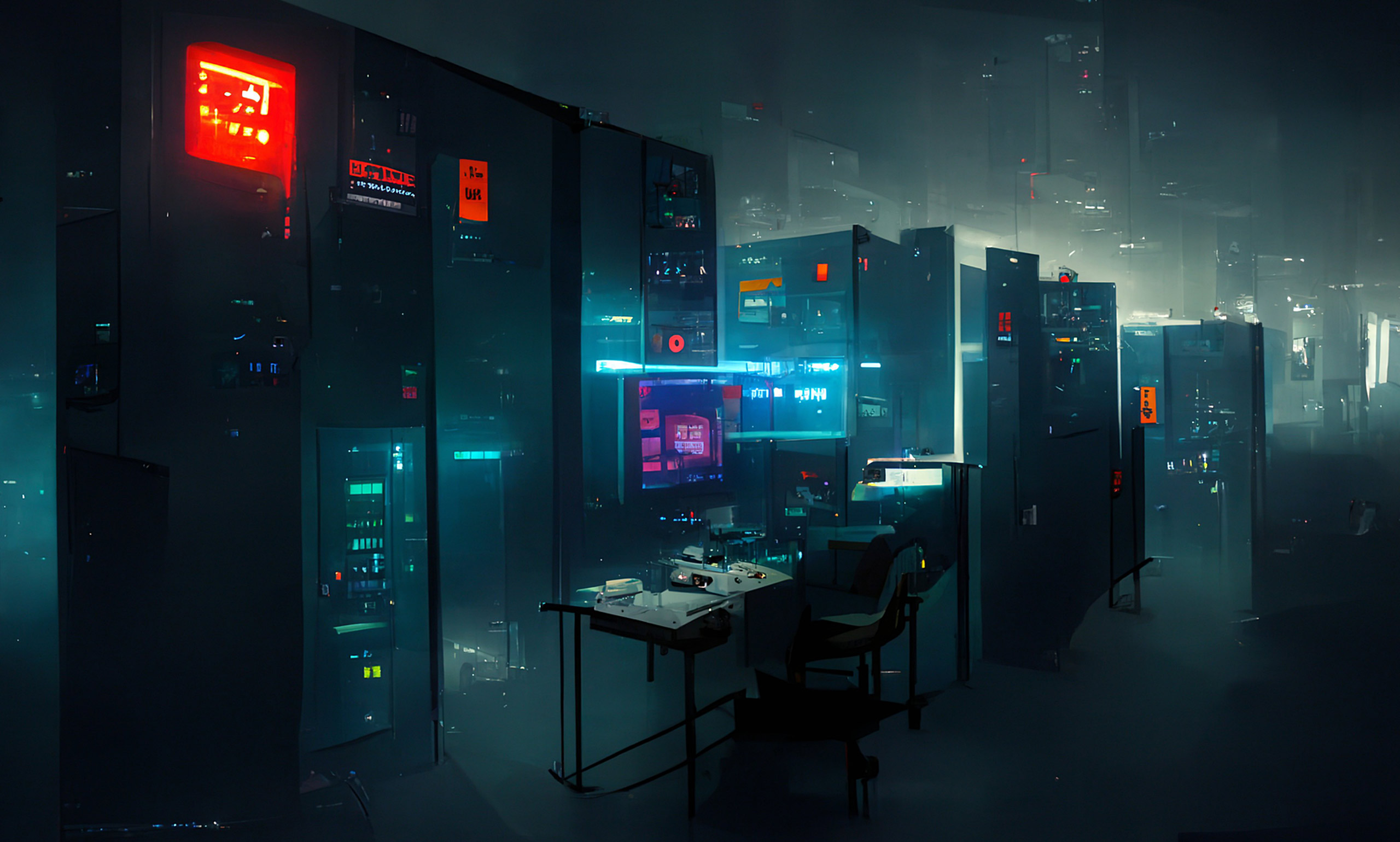
Creativity and technology are intimately linked throughout time. Humans have always used the available technology to express their creativity, be it a cave painting or an intricately crafted Roman mosaic. Human history is divided into ages that vary depending on continent and culture, but in Europe loosely covers the stone age (various), metal age (various), Roman, Medieval, Post-medieval and the industrial/modern ages. Throughout all these ages, technological development has influenced creative output. Technological developments have occurred at varying speeds but are currently moving forwards exponentially. It’s impossible to know what impact these will have in the future, but based on human history, we can hypothesise that people will find a way to utilise technology to create.
Technology and tools
Technology has provided a vast array of tools for humans to create. The various metal ages created blades, as well as casting technologies for sculpting. Blades that allow for fine splitting of timber allowed wooden stringed instruments to be crafted, which led to a wider variety of music being played. Mass paper production, allowed for that music to be written down and preserved, adding to the human knowledge base. Books can be written, information disseminated. Human creativity is both individual and a rolling wave of collective knowledge.
As a creative tool, one of the most influential of the modern age is the computer. The computer is to the 2020s what the camera was to the 1820s. We can now digitally draw, paint and write music. As computing power increases, so do the possibilities for creation. The availability of computers puts the power of creation into the hands of ordinary people, not just creative professionals. The ability to create at relatively low cost means the barriers to artistic creation, and potential career paths, are no longer limited to university graduates from wealthy countries.
Internet and social media
The internet and social media have changed the traditional publishing landscape. Creators no longer need to be vetted by publishers to show their work to the world. This crossover of roles is a significant burden for sole producers looking to make a living from their creative works. They are now expected to do all the jobs – the artist, the publicist, and the publisher all at the same time. All while working within a new set of algorithmic publishing constraints to produce relevant content.
The flip side of this is when social media and connectivity fosters collaborative projects. Online communities that encourage and create together. Social media is criticised for always showing the ‘sunny side’ of life, rather than real human connectivity. The public nature of social media encourages people to hide struggle while presenting idealistic content.
The nuance of this is that it varies depending on how you interact with social media. In my experience, the creative communities I have joined in with are friendly, encouraging and supportive. With active curation, social media can become a welcoming positive space. More and more creatives I see and interact with address both the positive and negative aspects of the platforms.
Generative AI
As computing becomes more powerful the role of Augmented Reality (AR) and Generative AI (GenAI) are becoming available to the public. AR enhances creativity by overlaying digital elements onto the real world, providing new opportunities for artistic expression, design, and storytelling. It enables immersive experiences, interactive artwork, and innovative visualizations, expanding the possibilities for creative exploration and pushing the boundaries of traditional mediums. GenAI may give a boost for ideation of creative works – be it an image created as reference for an artwork, or ChatGPT helping consolidate an outline for a written piece – akin to an extensive highly sophisticated search engine. Or a complete creation produced through iterative prompting, honed to achieve a desired result.
With the availability of GenAI systems, content can be created in an instant. Creative professionals who have been working hard to hone their craft and publish their work are now able to be replaced by a machine. However, as the GenAI machines run on a dataset, their product is limited. Not limited enough to guarantee all creative content professionals will be able to maintain their current profession, but enough to know that a truly unique human voice is still relevant. And, as the GenAI does as it is told, output varies widely and benefits from curation and editing from creative professionals who may use the GenAI as just another tool in their production toolkit.
Ethical considerations need to be made for the use of GenAI – the datasets it draws from are a repository of human knowledge – the original creators of which, deserve to profit from their labours.
The human impact
At the dawn of an era where creative output is no longer the exclusive domain of the human hand and mind, progressive countries are looking to safeguard their creative talent. This makes sense not only from a humanist perspective, but also an economic one. GenAI is uncharted territory, and speculation as to its longevity, economic viability and usefulness are already being discussed. In Ireland there has been legislation passed to guarantee a basic income for artists. This supports individuals and emphasises the importance of both preserving and growing human artistic creation.
While GenAI and Large Language Model (LLM) technologies are novel and provide instant gratification of brainstorming through to finished works, caution should be exercised. Initial concern about integration and reliance on LLM GenAI in education has moderated somewhat as educational institutions adapt and evolve to integrate the technology while maintaining pedagogical integrity. Also, as the technology advances and improves it also improves the ability to shape its use as a learning tool. The use of GenAI in visual arts education can prove helpful in allowing fast renders of ideas that are technically beyond the beginner artist which allows them to optimise higher order cognitive tasks. In much the same way as other multimedia tools, GenAI looks to be an interesting addition to the creative learning toolkit.
Adjunct not replacement
Creativity and technology have always been partners across human history. The challenge with the speed and scale of GenAI usage is how we integrate and enhance workflows while still maintaining human relevance. Augmentation of processes and expansion of toolkits rather than human replacement should be the goal. The automating of humans out of processes is not a bright future. The capitalist goal of profit needs to be balanced with the needs of humans so that the next great reshuffle of human industry does not cause enormous wealth disparity and suffering as it evolves.
The ability to generate your own movie or image or text with prompts, seemingly from thin air is truly remarkable. Technology and creativity are still intrinsically linked. Taste, editing and curation are important skills to harness these outputs into usable, tasteful and elevated outcomes. Experience and fundamental design knowledge are essential for shaping the results into truly unique creations rather than just crude mash-ups or cliches of existing work. Current GenAI development means that learning the theories of design can be primary and learning software interfaces becomes secondary.
By Emma Echter, May 2026
Image: Envato